Thursday, January 17, 2013

Snake Yawns: adorable AND informative

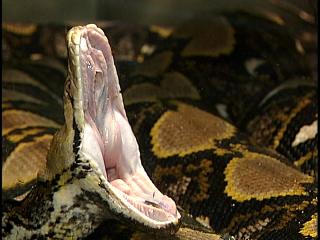
Long time, no blog post! For this post, I wanted to share one of my favorite snake behaviors: yawning.

Snake yawning, also called mouth gaping, was once thought to only prepare snakes for engulfing large meals (by stretching their jaws and re-aligning the fangs). However, it is now recognized as a way for snakes to pick up chemical cues from their environment (Graves and Duvall, 1983, Barbour and Clark 2012). By opening their mouths wide, chemicals make contact with the vomeronasal organ (also called Jacobson's Organ), which resides above the roof of the snake's mouth. Tongue-flicking, a well-known snake behavior, also allows the vomeronasal organ to process chemical cues. The tongue catches chemicals in the environment and brushes against the roof of the snake's mouth to transfer these chemicals to the organ. Mouth gaping often occurs after snakes probe their heads forward and tongue-flick.  


Yawning also gives snakes charisma. When their "stone cold" countenance is interrupted by a yawn, you can't help but see their softer side. Even more importantly for researchers like me, yawns reveal hidden snakes in their environment. In my research, I use fixed security cameras to record the behaviors of free-ranging snakes. However, oftentimes I lose the snakes in my videos because they are well camouflaged with their surroundings. When they yawn, they open their mouths so wide that a white flash appears on the camera frame, thus revealing their location to me!

So in conclusion, I love snake yawns because they are adorable and informative.

References:
Graves, B.M. and D. Duvall. 1983. Occurrence and function of prairie rattlesnake mouth gaping in a non-feeding context. Ethology 227:471-474.


Barbour, M. and R.W. Clark. 2012. Diel cycles in chemosensory behaviors of free-ranging rattlesnakes lying in wait for prey. Ethology 118:480-488.

Tuesday, October 16, 2012

Sign the Petition to Cancel Rattlesnake Republic


As a rattlesnake researcher, I have found that these animals are much different than the media portrays them to be. For example, many people are unaware that they have docile temperaments, and exhibit maternal care and kin recognition behaviors. Rattlesnakes are also one of the most abundant predators by biomass in their environment, making them an integral part of the ecosystem. Their population declines could have cascading effects, which may drastically change food web dynamics. Thus, it saddens me that an "educational" channel like the Animal Planet would promote the slaughter of such beautiful and important creatures. If you have not already done so, please sign the petition to stop their show, Rattlesnake Republic, which glorifies hunters who kill rattlesnakes for profit. It serves no other purpose than to miseducate the public, propagate fear, and deter conservation efforts on those species currently in decline. Please sign the petition to cancel this show here.


Monday, October 1, 2012

Where the *bleep* are the snakes?!

My life has been crazy busy: finishing up the field season, travelling to Vancouver, and moving to San Diego from Davis. Now that I am finally settling down, I found the time to travel to BORR last weekend to check on the snakes and collect venom (we are collaborating with the Gibbs lab to examine individual and seasonal variation in venom composition). However, after two days of searching, we found ZERO snakes. Zip, nada, nothing! It's not like we were looking for snakes randomly. I have 20 of them with implanted radio-transmitters--this means I can track their exact location. However, after hours of tracking and re-tracking and re-tracking, NONE were on the surface. What the *bleep* are they doing?!

Northern Pacific Rattlesnakes mate bimodally. This means that they have two mating seasons: the spring and the fall. I was hoping to see mating activity last weekend, but instead I saw nothing. However, I did track several females to the exact same burrow as males. I found many male-female pairings and I found one two male-one female cluster. Although I could not see the snakes, I suspect they could be mating in shelter.

I also noticed that most of my snakes were hidden within rocky outcrops. This is strange for my site because there are very few of these. In the summer, snakes mainly hide in abundant squirrel burrows, but I did find that they tended to overwinter in the outcrops. This makes me wonder if they are moving to their overwintering sites early. Normally overwintering ("hibernation") begins in November and lasts through March. Check out the nice outcrops the snakes were in:

One snake in here:

One male and one female shacked up here:

TWO males, one female here:

The weekend wasn't a total loss though. We saw a nice little spider crossing the road and found that one of our females gave birth:
Tarantula!

A little baby outside its den:

Who knows what the snakes were up to? Maybe it was just too hot of a weekend. So much for me collecting venom...

Friday, July 20, 2012

Hunting Snakes Have Patience

After seven weeks of grueling field work, we have completed this year's data collection on squirrel-snake interactions. This year was much different than last year--the lack of rain led to less overall vegetation cover and what appeared to be reduced snake activity. Last year we recorded several strikes on squirrel pups, but we only saw a few this year. In fact, by the time we left BORR, most of the snakes had lost body mass instead of gaining it, suggesting that they still had not successfully found a meal. Eating seems like such a simple task to us, but for snakes, capturing prey is harder than it looks. It may take weeks before a snake is able to eat--snakes must complete three steps to successfully consume a meal: (1) strike and hit the prey, (2) envenomate the prey, and (3) relocate the prey after envenomation.

Our video recordings have shown that snakes can falter at all three steps. We have seen many instances where a snake clearly strikes and hits a prey item, and yet it never searches for it. We suspect that the snake was unable to successfully envenomate the prey, so it was not worth its time to go look for it. We have also seen snakes strike and kill prey, but unable to find the prey afterward. This year we found a squirrel pup that had been envenomated; still alive, but clearly succumbing to the venom. Upon our arrival, the pup ran into the burrow where the snake that struck it was. The snake emerged an hour later looking for the pup. It moved in and out of a triangle of three burrows (NOT the burrow that the pup was actually in) for a total of 5 hours searching for the dead pup. It never found it. It is so interesting that a snake could wait for days just to strike a squirrel and yet, even when it does, it may not relocate it afterward.  

Teetee, male northern Pacific rattlesnake, in ambush right outside a squirrel burrow. It took him 13 days to get a meal.


Although it is tough being a foraging snake, feeding events still occur. Our most exciting feeding event this year was accomplished by Greeata, a female northern Pacific rattlesnake. It only took Greeata 2 days to successfully consume a squirrel pup. Initially, she chose several ambush sites outside of pup burrows at the base of a tree. However, in the end, she managed to strike a pup while underground beneath a log. While radio-tracking her, we found a dead squirrel pup just outside her burrow. We set up a camera on it, and lo and behold two hours later she emerged to consume it. It was quite an exciting day. Below I have posted a video of her selecting her ambush sites, and some pics of her consuming her big meal. Enjoy!


Greeata pulling the dead pup into the shade of her log

She swallows the pup at the entrance of her log burrow