Tuesday, May 31, 2011

BORR Species Accounts (So far)

Although the focus of our research is on squirrel-snake interactions, we have seen various other species on the Blue Oak Ranch Reserve. It has been a pleasure working on such pristine land. Below are a few pics of what we've encountered so far.

California Kingsnake (Lampropeltis getula)

Yellow-eyed Ensatina (Ensatina escholtzii)

 What a cutie

Crazy spider (I don't know my inverts, sorry)

Pacific Gopher Snake (Pituophis catenifer)

Me catchin another gopher snake

Western Skink (Plestiodon skiltonianus)

Alligator Lizard (Elgaria multicarinata)

Mule Deer

Monday, May 30, 2011

External Transmitter Attachment

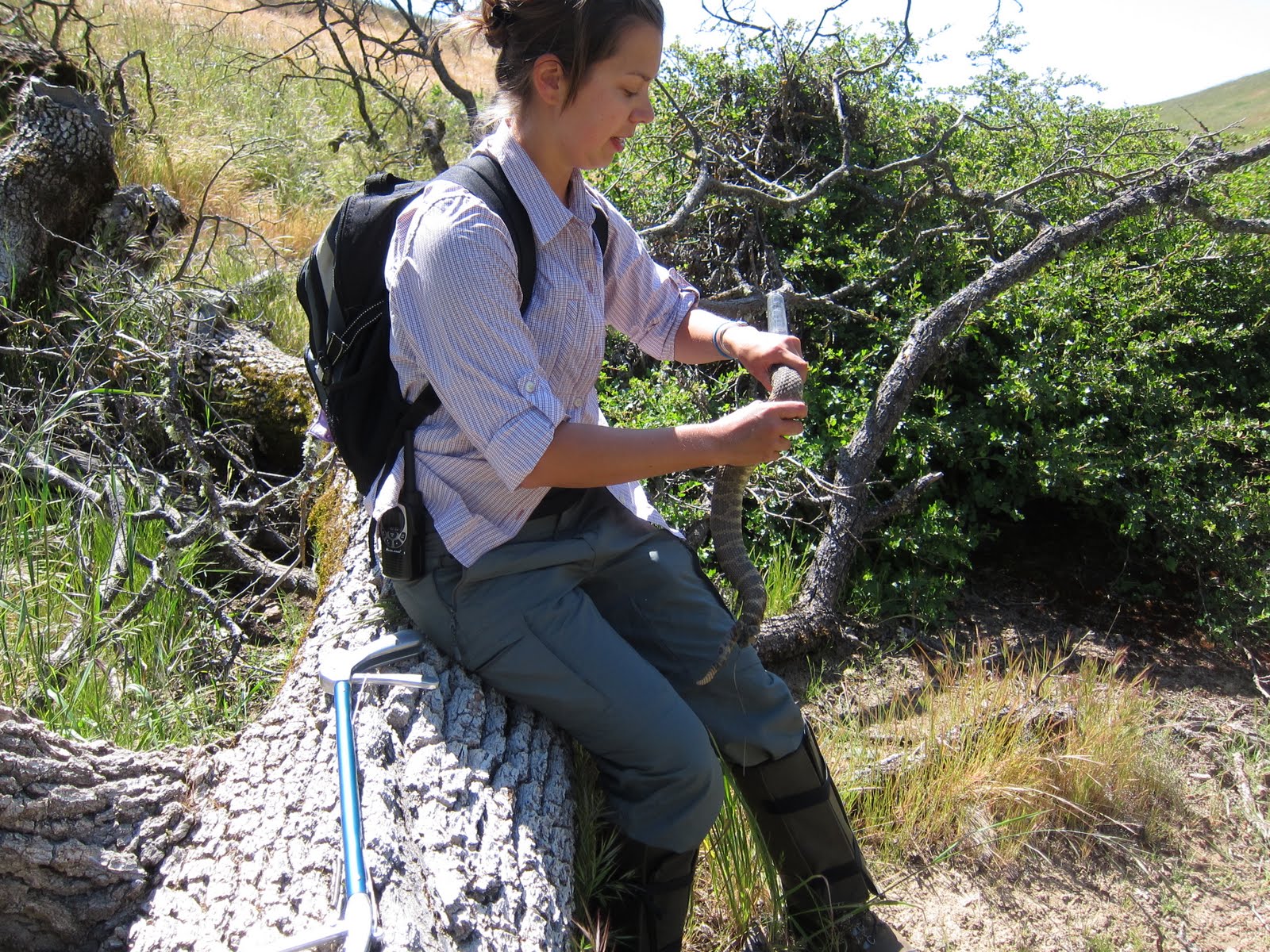
Most rattlesnake researchers implant radio-transmitters into their study animals. Such transmitters emit radio frequency signals that can be picked up by a receiver (sort of like how your car radio picks up station frequencies). This allows us to track individual snakes, which are normally hard to relocate due to their elusive nature (i.e. they like to hide in burrows and under rocks). However, since we are conducting a behavioral study, we tried out a new external attachment technique because surgically implanting transmitters can alter the behavior of the animals for up to two weeks. Check out the process below.

Rulon tubes a snake and we anesthetize it by placing a paper towel soaked in isoflurane at the end of the tube 

Anesthetized snake ready for a transmitter attachment

We sewed the transmitter through the skin of the snake, but not through the muscle (subcutaneous)

A released snake with external transmitter attached--we also duct-taped them in place

So far, most snakes have managed to rip off their external transmitters--We have been forced to do surgeries on the rest of our sample population

Thursday, May 26, 2011

Wranglin Snakes

Tracking a snake we released with a radio transmitter on it. The antenna that I am carrying picks up its specific radio frequency creating pulses that become louder as one approaches the snake.

Found it! It's in a squirrel burrow 


Picking up a relocated snake (this one is named Kashyyyk, that's right we have a Star Wars theme)

Tubing the snake so I can handle it safely

Finally got it in the tube


Wednesday, May 25, 2011

Trapping Squirrels

We started trapping California ground squirrels (Spermophilis beecheyi) a couple of days ago. We are trapping squirrels so that we can mark their fur. This will help us ID individuals during natural observations and experiments. We need to ID individuals because we are interested in knowing if squirrels interact with snakes close to or far away from their home burrow, and knowing which squirrels are more likely to approach snakes. Is it just the squirrel mothers, or do adult males also harass snakes?

To trap the squirrels we set up wire traps baited with sunflower seeds outside of active burrows. Below are the procedural steps we take to dye-mark their fur:

1) Scare squirrel into bag and hold down:

2) Inject hind leg with ketamine

3) Insert metal ear tags into both ears

3) Paint ID number onto fur (using nyanzol dye)

4) Measure body parts (snout to anus, leg length, tail length)

5) Wait for it to regain consciousness (perfect time for photo ops)


Although 96 traps are set out, very few squirrels have been caught. It takes them a while to become comfortable with the traps, but after they realize they can get a free meal, it will be hard to get them out.