Saturday, June 15, 2013

Good Friends and Snake Venom

My good friends, Matt Holding and Sloan Henningsen, paid a visit to our field site last week. Matt and I know each other from working in Dr. Emily Taylor’s lab at Cal Poly. Sloan is his awesome significant other and they make quite a terrific field team. Matt is now a Ph.D. student in the Gibbs Lab at The Ohio State University and we are collaborating on a project examining squirrel venom resistance and rattlesnake venom toxicity.

Many people do not know that ground squirrel blood contains proteins that neutralize rattlesnake venom. This means they can fight off the effects of envenomation, but are not immune (like how your body can fight off a cold). The level of resistance in squirrels correlates with blood volume – therefore pups are more susceptible to death by envenomation than adults. It was long thought that adults were essentially free from rattlesnake predation because of their resistance, but our research has shown that adults are commonly preyed upon by snakes.

Images of rattlesnake bite wounds from two different populations of ground squirrels. The top image shows the wound (circled in white) of a California ground squirrel with venom resistance. The bottom image show a wound caused by the same amount of venom in a squirrel without venom resistance.** 


For his dissertation, Matt is examining venom resistance in several populations of California ground squirrels.  My field site at BORR is one of the populations he is sampling from.  We are excited to see the composition of rattlesnake venom in relation to squirrel blood resistance especially since adult squirrels are eaten by snakes at our site. We are also interested in examining the individual variation in resistance (how resistance differs from squirrel to squirrel) and if this variation correlates with squirrel anti-snake behaviors (tail-flagging, alarm calling, substrate throwing, etc.).

Matt demonstrated several of his extraction methods while he visited us. Please enjoy the pictures below. Also, check out his awesome blog here.


 We scare a trapped squirrel into a bag


 Matt puts the squirrel under using a light anesthetic 


I measure various body parts on the squirrel
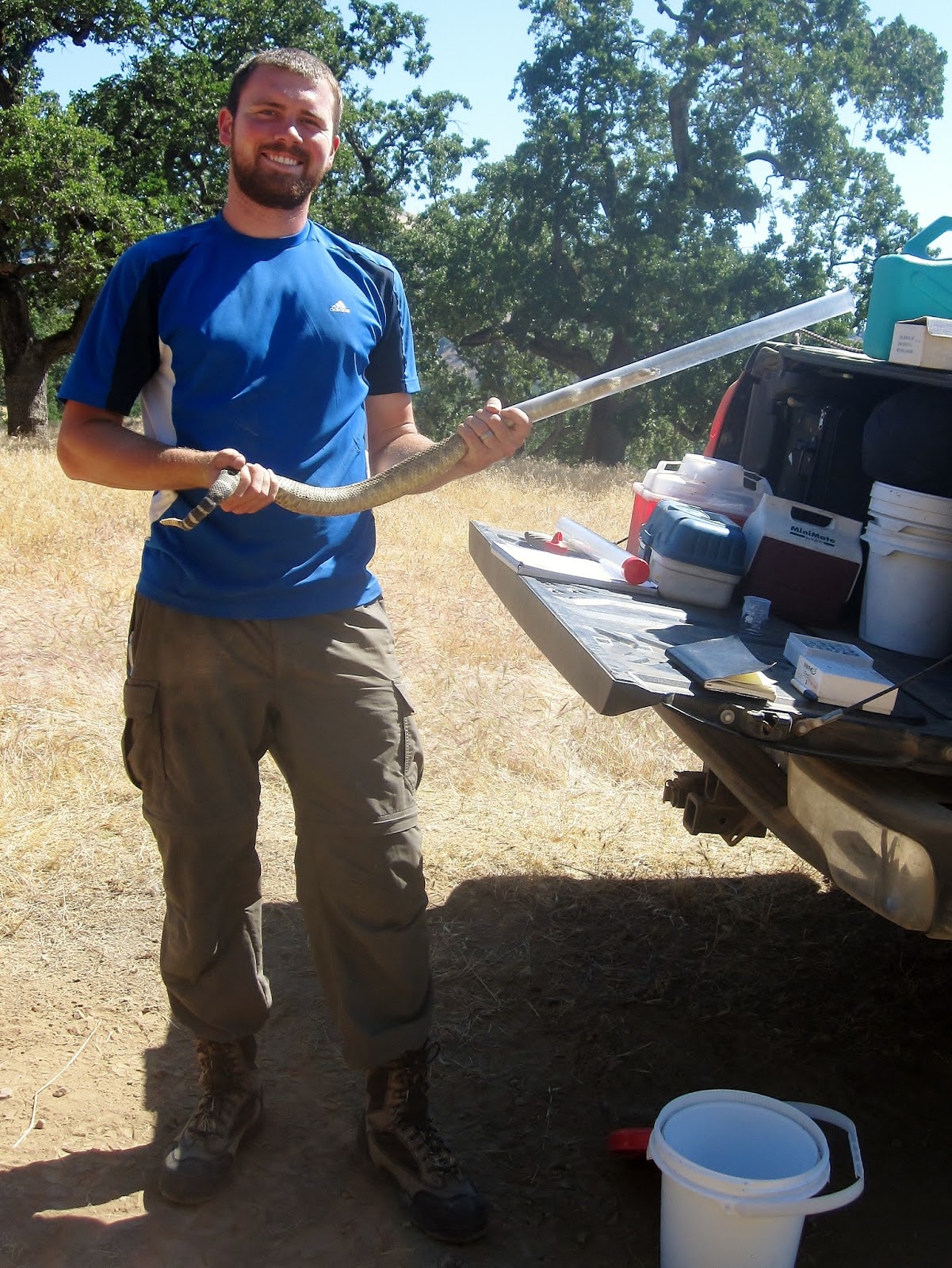


 Matt tubes a rattlesnake


We draw blood from the snake 


 Matt collects its venom (you can see some in the bottom of the glass)
DO NOT TRY ON YOUR OWN!!


**Image from: Owings, D. H., and R. G. Coss. 2007. Hunting California Ground Squirrels: Constraints and Opportunities for Northern Pacific Rattlesnakes. Biology of the Rattlesnakes.

Monday, June 10, 2013

The Field Season 2013 Begins!


Hi all!

I was finishing up my coursework the past months, but now I am back in business! The field season started three weeks ago and we are chugging along slowly but surely. I have five field interns working with me and they are wonderful additions to Team Crotalus (fyi - Crotalus is the genus for the rattlesnakes). This field season, our main focus is to conduct two field experiments testing the function of squirrel tail-flagging. We hypothesize that squirrels tail-flag to rattlesnakes to signal their vigilance and readiness to evade a snake strike. If this is true, (1) squirrels should evade snake strikes more often when tail-flagging and (2) snakes should strike less often at tail-flagging squirrels. We present a device to squirrels that simulates a snake strike to test prediction 1(see images below), and we use Robosquirrel to test prediction 2.  These experiments may sound simple, but working with wild animals can be unpredictable and frustrating (because they do not cooperate with you). It will likely take all summer to collect a large enough sample size to test our hypothesis.  

Screen shots from a trial with the strike simulating device. The focal squirrel is circled in red in the upper shot. At 0.00 seconds, the spring within the device (indicated by the yellow arrow) has not been released. By 0.58 seconds, the spring has been released and the squirrel has evaded it.


In addition to performing the abovementioned field experiments, we radiotrack 20 wild rattlesnakes each day. Since snakes are secretive and elusive creatures, we would not be able to understand how they interact with squirrels without knowing where they are at all times. We often catch glimpses of interesting behaviors because we track them so often. Please enjoy the video below that my intern, Mike, made showing the radio-tracking process and a great observation we made on our first day out in the field.   


Thursday, January 17, 2013

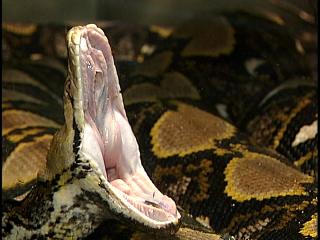
Snake Yawns: adorable AND informative

Long time, no blog post! For this post, I wanted to share one of my favorite snake behaviors: yawning.

Snake yawning, also called mouth gaping, was once thought to only prepare snakes for engulfing large meals (by stretching their jaws and re-aligning the fangs). However, it is now recognized as a way for snakes to pick up chemical cues from their environment (Graves and Duvall, 1983, Barbour and Clark 2012). By opening their mouths wide, chemicals make contact with the vomeronasal organ (also called Jacobson's Organ), which resides above the roof of the snake's mouth. Tongue-flicking, a well-known snake behavior, also allows the vomeronasal organ to process chemical cues. The tongue catches chemicals in the environment and brushes against the roof of the snake's mouth to transfer these chemicals to the organ. Mouth gaping often occurs after snakes probe their heads forward and tongue-flick.  


Yawning also gives snakes charisma. When their "stone cold" countenance is interrupted by a yawn, you can't help but see their softer side. Even more importantly for researchers like me, yawns reveal hidden snakes in their environment. In my research, I use fixed security cameras to record the behaviors of free-ranging snakes. However, oftentimes I lose the snakes in my videos because they are well camouflaged with their surroundings. When they yawn, they open their mouths so wide that a white flash appears on the camera frame, thus revealing their location to me!

So in conclusion, I love snake yawns because they are adorable and informative.

References:
Graves, B.M. and D. Duvall. 1983. Occurrence and function of prairie rattlesnake mouth gaping in a non-feeding context. Ethology 227:471-474.


Barbour, M. and R.W. Clark. 2012. Diel cycles in chemosensory behaviors of free-ranging rattlesnakes lying in wait for prey. Ethology 118:480-488.

Tuesday, October 16, 2012

Sign the Petition to Cancel Rattlesnake Republic


As a rattlesnake researcher, I have found that these animals are much different than the media portrays them to be. For example, many people are unaware that they have docile temperaments, and exhibit maternal care and kin recognition behaviors. Rattlesnakes are also one of the most abundant predators by biomass in their environment, making them an integral part of the ecosystem. Their population declines could have cascading effects, which may drastically change food web dynamics. Thus, it saddens me that an "educational" channel like the Animal Planet would promote the slaughter of such beautiful and important creatures. If you have not already done so, please sign the petition to stop their show, Rattlesnake Republic, which glorifies hunters who kill rattlesnakes for profit. It serves no other purpose than to miseducate the public, propagate fear, and deter conservation efforts on those species currently in decline. Please sign the petition to cancel this show here.